Metro
The Metro is a controller that runs a tempo clock and fires its pads on a beat grid. Drop modules onto it and the metronome triggers them in time — as a click, a drum pattern, an arpeggiated pulse, or a fully hand-drawn sequence.
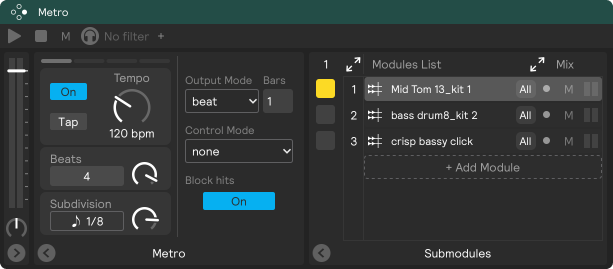
Transport
On/Off
Starts and stops the clock. Starting always re-anchors to the downbeat (step 1 of bar 1).
Tempo
The tempo of the metronome in beats per minute (BPM). It accepts any number from 30 to 3,000. You can use the knob or type a number in the field.
Tap
Tap repeatedly to set the tempo by ear.
Meter
Beats
Beats per bar (1–16) — the top number of a time signature.
Subdivision
The rate the grid ticks at, as a note value relative to the beat.
Subdivision values
Subdivision values, slowest to fastest:
| Value | Meaning |
|---|---|
1/2. | dotted half |
1/2 | half notes |
1/4. | dotted quarter |
1/4 | quarter notes (one tick per beat) |
1/8 | eighths (two ticks per beat) |
1/8T | eighth-note triplets |
1/16 | sixteenths |
Odd subdivisions (triplets, dotted values) need more than one bar to line back up with the beat. The metro raises Bars automatically to the smallest span where the full cycle fits, so the pattern always repeats cleanly.
Velocity
The downbeat always fires at full velocity. The two knobs set the rest:
Pulse
Velocity of the non-downbeat beats.
Subdivision
Velocity of the in-between subdivision ticks.
Output Mode
Sets how pads (rows) map onto the grid. Pads are numbered top to bottom.
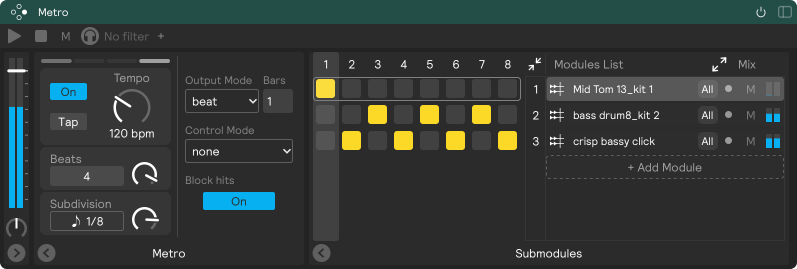
Beat
One pad per step, chosen by metric importance: the downbeat fires pad 1, regular beats fire pad 2, subdivisions fire the lower pads. Exclusive — only one pad sounds per step.
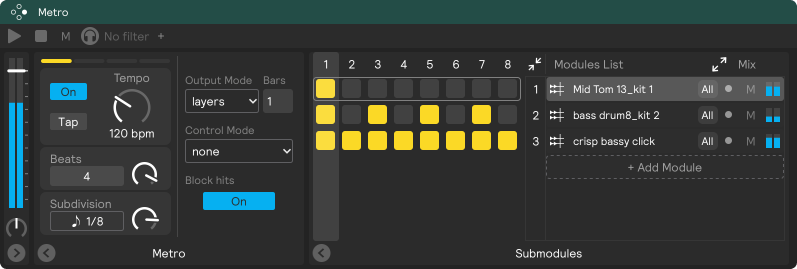
Layers
Pads fire independently and can overlap: pad 1 = downbeat, pad 2 = every beat, pad 3 = every subdivision. With fewer than three pads, layers collapse onto the pads available.
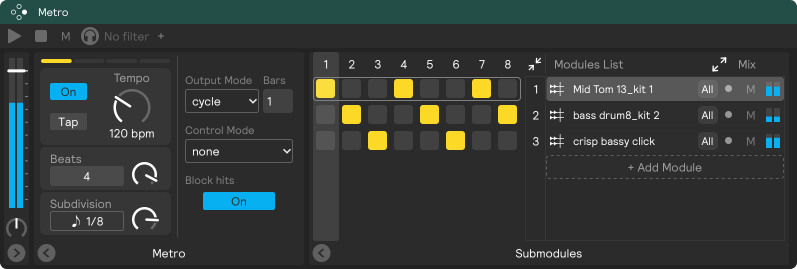
Cycle
Each step advances to the next pad in turn and wraps around — a rotating pulse.
Pulse
Every step fires pad 1 only.
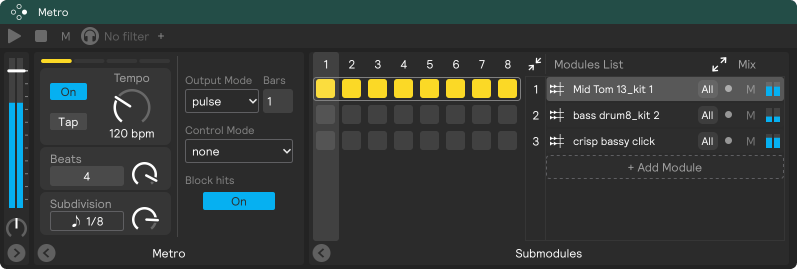
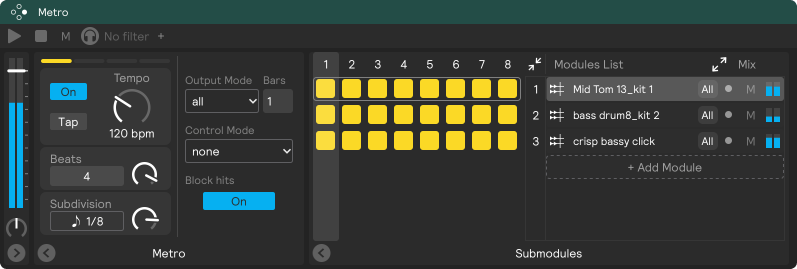
All
Every pad fires on every step (all pads sound together). This is the classic metronome / original metro behavior.
Custom
The grid is whatever you drew by hand.
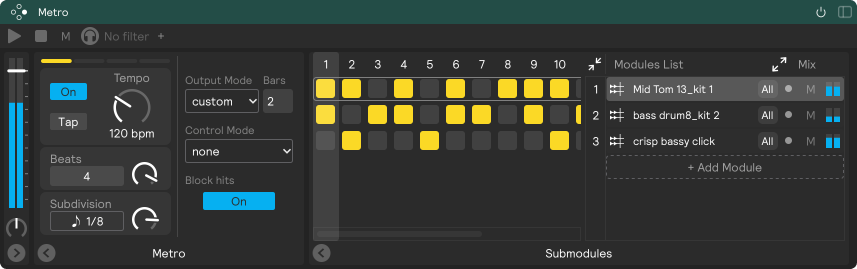
Custom is special: it is not regenerated. You enter Custom either by picking it from the menu or simply by editing any cell in the grid — the metro captures your edit and switches to Custom automatically (undoable). Once in Custom, adding, removing, or reordering pads keeps your drawn pattern aligned to each pad; a newly added pad starts blank. In every other mode, changing the pads re-derives the grid for that mode without leaving the mode.
Input (Control Mode & Block hits)
The metro can also react to incoming hits, not just its own clock.
Control Mode — how an incoming hit affects the transport:
| Mode | Behaviour |
|---|---|
| None | Hits don't touch the transport. |
| Start | The first hit starts the clock; later hits pass through. |
| Restart | Every hit restarts the clock from the downbeat. |
| Toggle | Each hit toggles the clock on/off. |
Block hits — when on, incoming hits are consumed by the metro and not forwarded to its pads. Turn it off to let hits pass through to the pads in addition to driving the transport.
To use the Metro as a click, turn on Block hits and turn on the Monitor Mix button in the header row. This will send the Metro layer to any outputs with the Monitor Mix enabled and exclude it from the Main Mix.
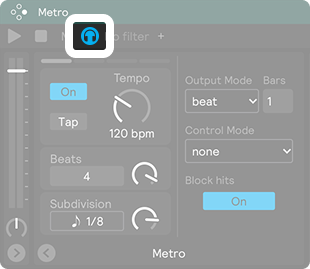
If you're looking for a good sample to use as a click sound, check out the cross-stick from the Sol Seco kit. You can find it in the library under:
Percussion Section > Detailed > Sol Seco > muted brass snare > cross stick > muted brass snare_cross-stick_v3-1