File Menu
The File menu is in the menu bar at the top of the screen. It's where you open, save, and manage your sessions.
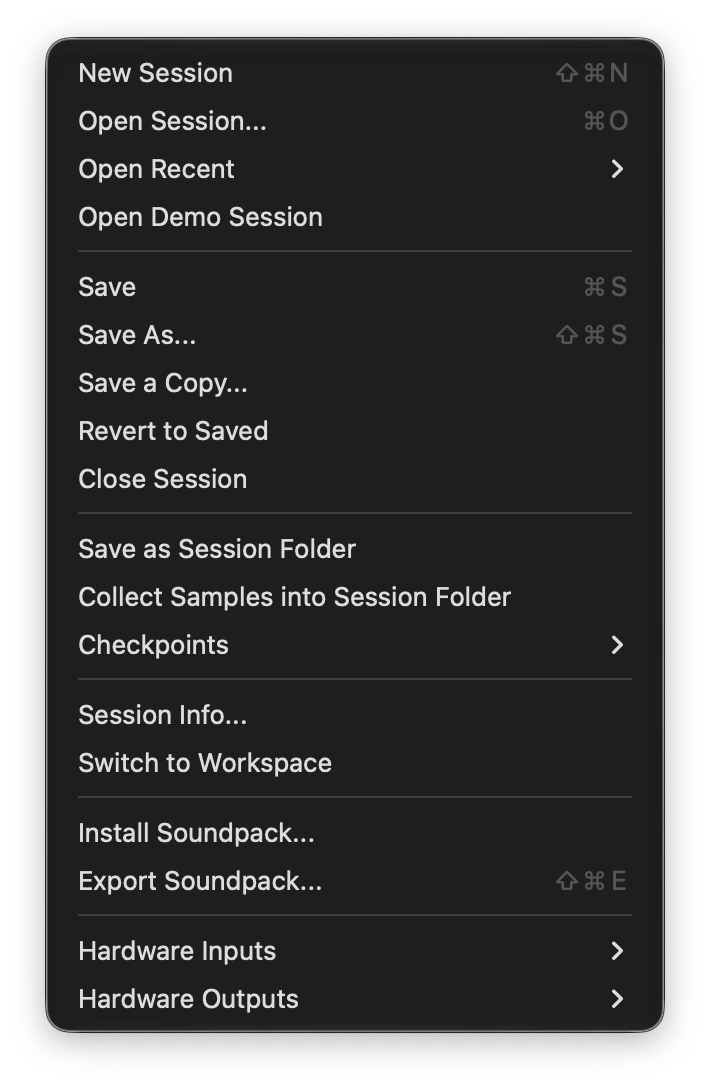
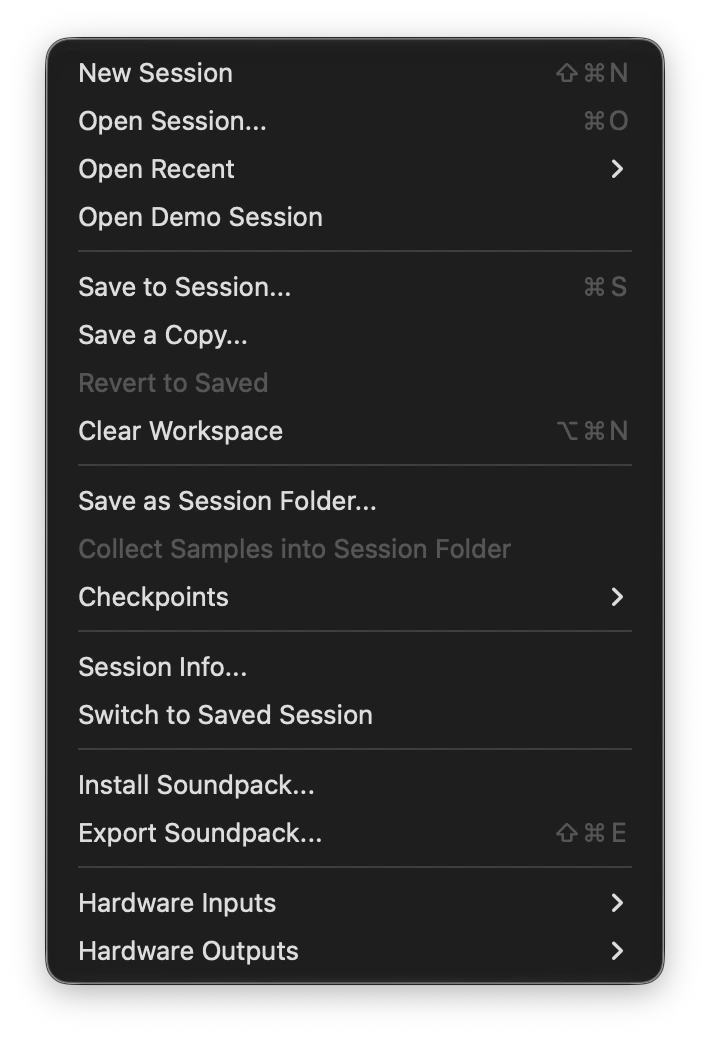
The menu has the same layout whether you're working in the workspace or in a session, so every item stays in the same place. What the current slot can't do is greyed out, and a few items change their wording because the same action means something different in each. An item ends in … when it's going to ask you for something first.
- In a session
- In the workspace
Opening
| Item | What it does |
|---|---|
| New Session | Starts a fresh, untitled session in the session slot. Nothing is written to disk until you save, at which point you'll be asked for a name and a location. |
| Open Session… | Opens a session file (.sp2) from your computer. It becomes the active session. |
| Open Recent | The same, from a list of sessions you've opened recently. |
| Open Demo Session | Opens the demo session that comes with Sensory Percussion: a collection of sets that show off what it can do, from rich chordal kits to detailed acoustic drum mappings. |
Saving
| Item | What it does |
|---|---|
| Save | Saves your changes to the session's file. Reads Save… while the session is untitled, because it asks for a name first. |
| Save to Session… | In the workspace, in place of Save. Turns the workspace into a named, saved session and leaves the scratchpad clean behind you. |
| Save As… | In a session. Saves under a new name, and the new file becomes the active session. |
| Save a Copy… | Writes what's on screen to a file without changing anything in the app. You stay where you are, and the copy doesn't become the active session. |
| Revert to Saved | Discards your unsaved changes and reloads the session from its file. A backup of what you discarded is kept. Only available in a session with something to discard. |
| Close Session | In a session. Puts the session away and returns you to the workspace. |
| Clear Workspace | In the workspace, in place of Close Session. Blanks the scratchpad so you can start over. A backup is kept in case you need it back. |
Session folder
These keep a session, its samples, and its checkpoints together. See Session Folders and Checkpoints for the details.
| Item | What it does |
|---|---|
| Save as Session Folder | Wraps the session in a folder of its own, without moving any samples. Greyed out once the session lives in one. |
| Collect Samples into Session Folder | The same, and also copies every sample and image the session uses into the folder, so you can move it to another computer. Needs a session, so it's greyed out in the workspace. |
| Checkpoints | Create a dated checkpoint of the session, or go back to an earlier one. Available once the session lives in a session folder; until then it offers Save as Session Folder. |
Samples from the Core Library and installed sound packs aren't copied into a session folder. Install them separately on each computer.
Session
| Item | What it does |
|---|---|
| Session Info… | Edits the session's details: its name, description, credits, tags, and version number. Handy if you plan on exporting the session as a sound pack. |
| Switch to Workspace / Switch to Saved Session | Jumps to the other slot, leaving the current one parked exactly as it is. Switch to Saved Session is greyed out when the session slot is empty. |
Sound packs and hardware
| Item | What it does |
|---|---|
| Install Soundpack… | Installs a Sunhouse sound pack (.spz file) into your library. |
| Export Soundpack… | Exports your session as a sound pack (.spz) file. You choose which presets and samples to include and edit the pack's name, description, credits, and version. Learn more. |
| Hardware Inputs ▸ | Load…, Open Recent, and Save As… for a hardware input list (.spi file). |
| Hardware Outputs ▸ | Load…, Open Recent, and Save As… for a hardware output list (.spo file). |
Hardware inputs and outputs belong to the app, not to the session, so loading a session never changes them. Saving them to a file is useful for moving your setup to another computer.
Loading an input or output list replaces the ones you have now. Use Save As… first if you want to keep them.
To keep several setups and switch between them, like home and stage, use environments instead. An environment saves your hardware inputs and outputs together with your audio, MIDI, and OSC settings, and loads them all in one click. Loading a file from another computer may need a hardware remap.
Keyboard shortcuts
| Shortcut | Item |
|---|---|
| ⇧ + ⌘ + N | New Session |
| ⌘ + O | Open Session… |
| ⌘ + S | Save (or Save to Session… in the workspace) |
| ⇧ + ⌘ + S | Save As… |
| ⌥ + ⌘ + S | Create Checkpoint |
| ⌥ + ⌘ + N | Clear Workspace |
| ⇧ + ⌘ + E | Export Soundpack… |
You can change any of these in Settings → Keyboard Shortcuts.