Controllers
Controllers are modules that perform some sort of action on their submodules. These actions include mapping, assigning, quantizing, routing, sequencing, and more. Unlike Generators, Controllers don’t create sounds by themselves.
Controllers can be found in the Build section of the library.
There are kinds of controllers, each of which serves a different purpose:
Drum Pads
Map modules to different zones on the drum
Grid Pads
Assign modules to grid pads and trigger them with the Pads Input
Cymbal Pads
Assign modules to cymbal pads and trigger them with the Cymbal Input
Hi-hat Pads
Assign modules to hi-hat pads and trigger them with the Hi-hat Input
Hi-hat Pedal Controller
Blend hi-hat layers from open to closed with the hi-hat pedal
Sequencer
Cycle, randomize, or manually control the order in which the modules within are played.
Group
Group modules together
Hit Controller
Send each hit to one of its submodules, chosen by velocity, timbre, speed, an LFO, or any other control value
Note Controller
Turn your playing into notes in a scale, chosen by velocity, timbre, speed, an LFO, or any other control value
Metro
A metronome module
Grouping modules into a controller
You can drag modules into a controller one at a time, but it's often quicker to select them first and wrap them in a controller in one step. In the Edit view, select one or more modules, then right-click them or use the Edit menu:
| Command | Shortcut | What it does |
|---|---|---|
| Group | ⌘ + G | Wraps the selected modules in a Group controller. |
| Group into… | ⌥ + ⌘ + G | Wraps them in the controller you choose, like Drum Pads or a Sequencer. |
| Ungroup submodules | ⇧ + ⌘ + G | The reverse: removes the selected controller and puts the modules inside it in its place. |
For example, drag a handful of samples in from the library, select them, and choose Group into… → Drum Pads to spread them across the zones of a drum without opening the library again:
Grouping is also a good way to tidy a busy set. Grouped modules keep their input filters, so nothing changes about how they play. See How to Navigate Complex Sets.
Advanced Mapping
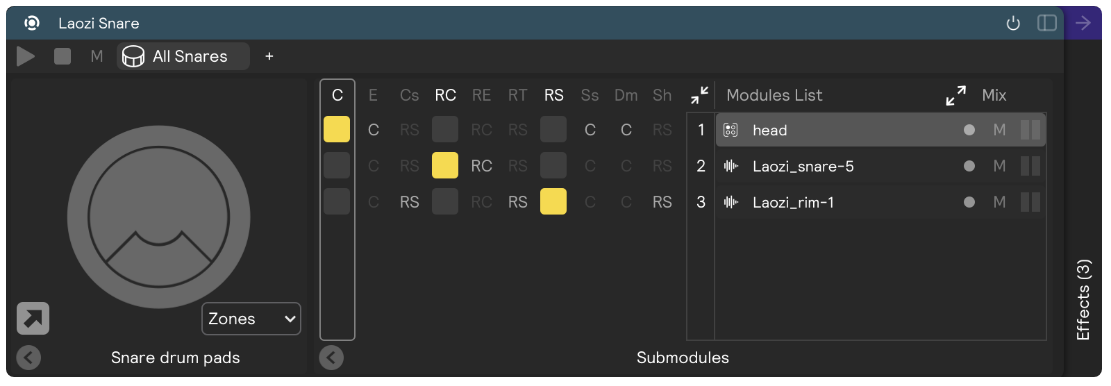
The advanced mapping view exists in the Submodules panel of Drum Pads, Hit Controllers, and Sequencers. It can be opened by clicking the button to the left of the Modules List: 
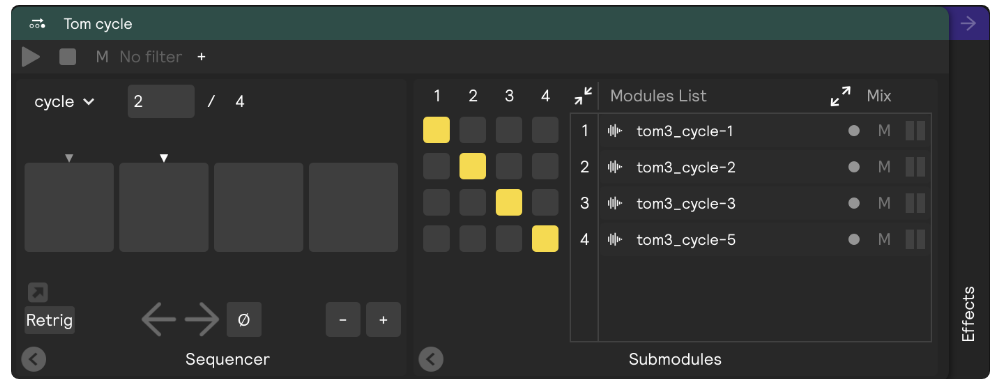
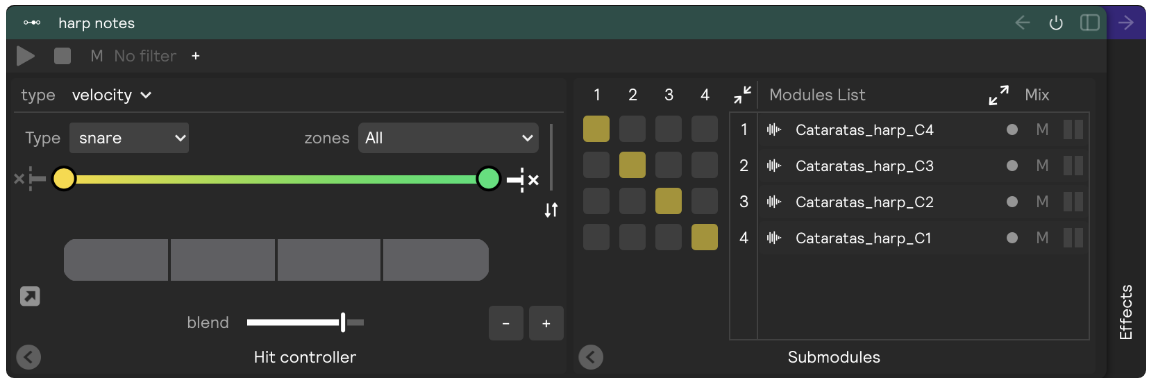
This will open up a matrix with a grid of squares that can be activated by clicking them. The vertical axis always represents the submodules listed to the right, while the horizontal axis is different for each controller type. Clicking an inactive grey square will activate it, assigning the corresponding submodule to the corresponding step of the horizontal axis.
Here are the different advanced mapping views of the 3 different controllers that have them:
In Sequencers, modules can be assigned to different steps in a sequence:
In Hit Controllers, modules can be assigned to hit ranges, which go from low to high values of whatever mode you're using (velocity, speed, or timbre):
In Drum Pads controllers, modules can be assigned to different zones of the drum: