Edit View
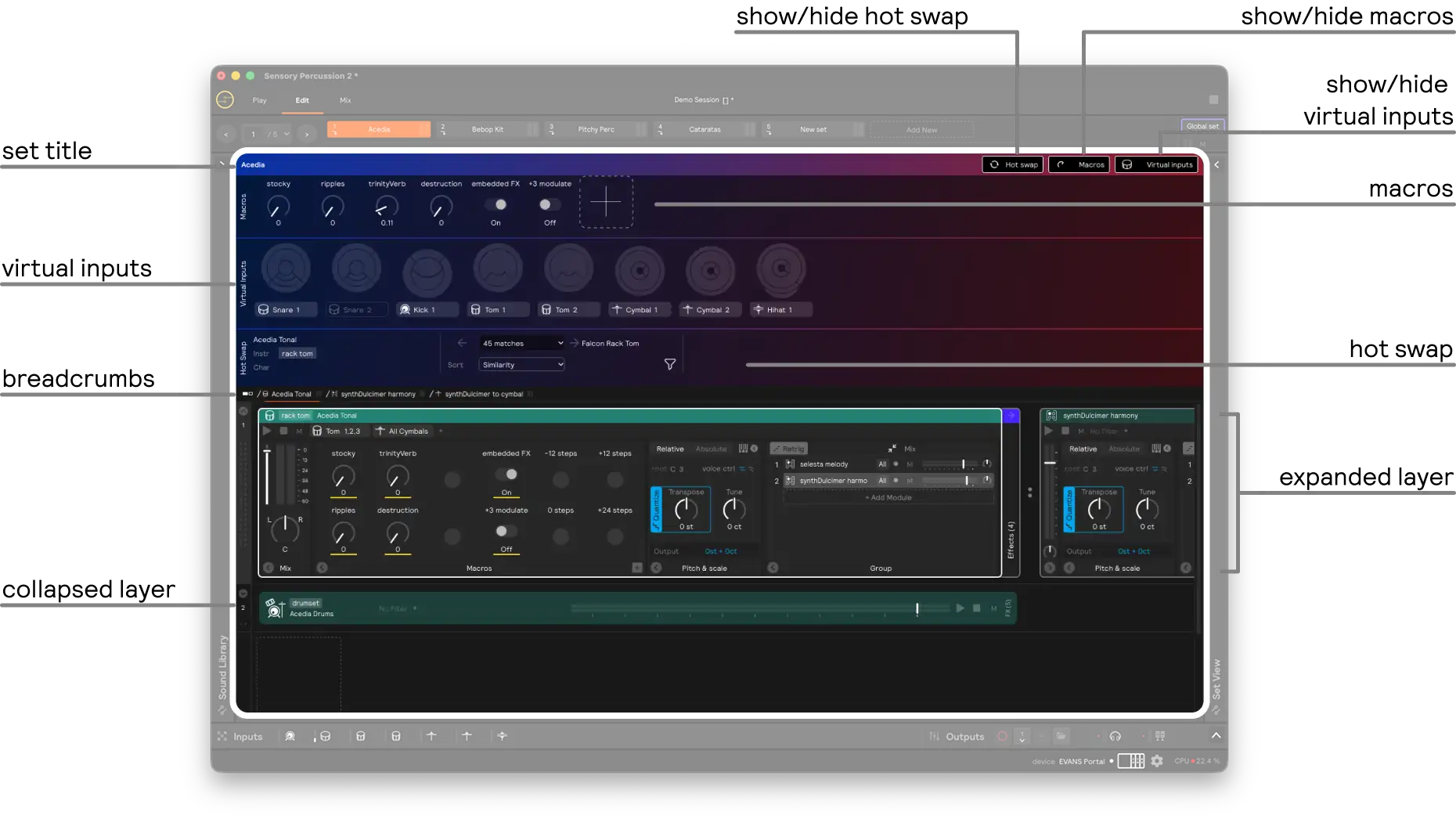
Edit view allows you to look under the hood of your set and tweak things at a more granular level, allowing you to dive deep into all the sonic possibilities Sensory Percussion V2 has to offer.
Layers
Edit view revolves around layers. Layers are made up of modules, which are the fundamental building blocks of Sensory Percussion V2, so this is the section you will be spending the most time in while building your sets. If you're starting with an empty layer, simply drag and drop any element from the library to create a new layer. From here, you can copy and paste layers and add different modules as you like. For more information on how layers work, check out the Software Concepts page.
Breadcrumbs Bar
This bar is a helpful way to navigate your set, especially if it has lots of long, complex chains of modules. It lists all of the modules that are currently visible in whatever layer you have selected, and when you right-click it, you can see a tree view of your entire set's structure! For more info on how to use the breadcrumbs bar to quickly navigate your set, check out the How to Navigate Complex Sets page.
Virtual Inputs
In Edit view, you can create/delete virtual inputs, and also change the routing between virtual and hardware inputs by changing the number next to the virtual input drum type (from snare 1 to snare 2, etc). It is also a collapsible section in this view. So, if you don't want to deal with virtual inputs at the moment and would prefer more room for your layers, simply click the "Virtual Inputs" button in the top right corner of the window to collapse this section. For more information on how virtual inputs work, check out the Virtual Inputs page.
Macros
Since your sonic layers take up most of the Edit view screen, there is no need to switch between set macros and layer macros like you do in Play view. In Edit view, all macros in this section apply to the whole set, while each individual module also has the ability to host macros. In the Macros section, you can create, delete, and assign macros. It's also a collapsible section in this view, so if you don't want to deal with set macros at the moment and would prefer more room for your layers, simply click the "Macros" button in the top right corner of the window to collapse this section.
Hot Swap
The hot swap feature allows you to quickly swap out Instruments modules for another. This is a great way to quickly audition different drums. Read more about using the hot swap feature here.
That was a lot of information, so here's a table showing the different ways that each section works in the two views of Sensory Percussion V2:
| Play | Edit | |
|---|---|---|
| Virtual Inputs | • audition limited zones by clicking on the drums | • audition all zones • change routing |
| Layers | • adjust layer volume/panning • mute/solo layers • drag in layer elements from the library | • create/delete layers • add elements to layers from the library • control routing, effects, macros, assignments, and more |
| Macros | • adjust existing macro knobs • select a layer to switch from set macros to layer macros | • create/delete set macros • assign set macros to parameters within layers • adjust set macro knobs |
| Hot Swap | • Hot swap instrument modules | • Filter hot swap options by character tags • Change the input type of the hot swap |
| Set Styling | • right-click to change the set image and colors | • not available in Edit view |